
Search:
Flight Projects | Sciences and Exploration
Linear Fit Algorithm Description
The linear fit algorithm uses UV measurements at a number of discrete bands for retrieval of the amounts of atmospheric ozone(W) and sulfur dioxide (X) and the effective surface reflectivity (R) simultaneously. This set of discrete bands contains bands centered at six TOMS wavelengths and four additional bands centered at the local minima and maxima of SO2 absorption cross sections in the wavelength range between 310.8 nm to 314.4 nm. These four additional bands are the same as those used in the band residual difference (BRD) method.
The basic idea of retrieval is to derive these geophysical parameters: W, X, and R,
by adjusting them until the difference at these discrete bands between the
measured radiances (Iobs) and the
forward model calculations (I) are minimized. Our forward calculations
employ accurate radiative transfer model that accounts for the multiple
Rayleigh scattering and rotational Raman scattering (known as the Ring effect),
ozone and SO2 absorptions, and surface reflectivity.
The minimization starts with an initial estimate of total ozone (Wt) and the effective surface reflectivity (Rt) using the TOMS-V8 approach.
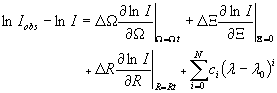
Then the residuals, calculated at the discrete wavelengths,
can be expressed by the equation above, in which the polynomial (quadratic in
our implementation) is used to account for the wavelength dependent effect of
surface albedo and aerosol on the effective reflectivity. The minimization can
be solved as the linear least square fitting of the residuals by the weighting
functions:  , and the polynomial coefficients
  . The weighting functions are calculated based on the TOMS-V8
climatology for a priori ozone and temperature profiles, and assumed SO2
profiles centered at a prescribed altitude.
. The weighting functions are calculated based on the TOMS-V8
climatology for a priori ozone and temperature profiles, and assumed SO2
profiles centered at a prescribed altitude.
The solution yields adjustment to the initial estimates of ozone and effective surface reflectivity, and the vertical SO2 column directly.